Showing posts with label The Detective Scribbles. Show all posts

Friday, February 10, 2012

The Detective Scribbles, No. 13, Sherlock Holmes

Here is the last drawing in the series entitled "the Detective Scribbles," and what better way to end a series than with the world-renowned and, hands-down, greatest and most influencial fictional detective that has ever graced the world of literature, Sherlock Holmes.
The violin-playing, smoke-stack that is Sherlock Holmes was introduced in 1887 in The Study in Scarlet which spurred a world-wide fervor for the people at that time. No one, besides Edgar Allan Poe with his creation of C. Auguste Dupin (which was part of the inspiration for Holmes' creator), had ever written of such an ingenious detective. In 1887, a doctor by the name of Arthur Doyle was struggling with his practice and found that he had some time to kill, so he had written some detective stories (note that this was around the ballpark of 1887, sometime before he wrote Scarlet). Now the curious beginnings of Holmes are quite fascinating, even some of the myths of the fictional detective have been set in stone are quite curious, too.
Most know the story now, with the newly released sequel of Sherlock Holmes (starring Robert Downey Jr. and Jude Law) entitled Sherlock Holmes: A Game of Shadows as a sort of catalyst to the researcher and reader of the stories, Doyle had attended Edinburgh University and one of his instructors was a brilliant doctor by the name of Joseph Bell, who was much like Holmes in every way. Bell was the physician to Queen Victoria, so he was, needless to say, quite renowned for his medical practices, but he wasn't only renowned for his way around the medical table, but he was famed for his role as a diagnostician (which helped when he was researching a particular case in a borough in London in 1888, although the murderer was never brought to justice, and that case was the case of Jack the Ripper). Bell could deduce from a person's appearance their habits, their maladies, even their occupation, just through pure observation and careful notes. His brilliance enthralled the young Doyle and he thought that it was fitting to put those characteristics of deduction into the character of Sherlock Holmes (who was originally called Sherringford Hope, I believe, but I may be wrong) and cast himself as Holmes' Boswell (as Holmes alludes to on occasions in the stories), Doctor Watson (who was originally called Ormond Sacker, I think, but, I very well could be wrong with this one, too). Anyway, after Doyle created the inquisitive and ingenious detective, the public would entrust Doyle to write them for years to come, no matter what.
When it came to the the winter of 1893, however, Doyle, much like Poirot's creator Agatha Christie became years later, was absolutely fed up with Holmes. After he had been with Holmes nearly a decade, and writing countless amounts of short stories and some novels, Doyle killed off the world's favorite fictional detective in a deathly battle with Holmes' nemesis, the unscrupulous Professor James Moriarty, at Reichenbach Falls in Switzerland. Even though it was a great weight off of Doyle's shoulders, and just when he was preparing to set off in a new direction with the brutish character of Professor Challenger (which would later inspire the Jurassic Park movies), the public was absolutely outraged that Sherlock Holmes was "dead and gone" (that is only the approximate quote from Doyle, not the absolute exact quote). Doyle, quite reluctantly, put pen to paper, once again, and penned Holmes' next adventure explaining his "death" in 1903, nearly ten years after his fall, in the short story "The Adventure of the Empty House." I quite enjoy this story mainly because of Watson's reaction to Holmes' triumphant return (because Holmes is, at first, disguised as an aged bookseller). After he sheds his disguise, Watson turns around to see the gaunt and aquiline figure of Holmes and Watson faints on the spot.
After Holmes' return, Doyle was roped into doing more stories about the detective, calculating a grand total of fifty-six short stories and four novels, I believe. Even though Doyle went on to write more stories about the Boer War and more Professor Challenger stories, Doyle and his brainchild of Sherlock Holmes, the great monster of a character that Doyle created on pure whim, would be etched on the panels of history as the greatest fictional character that had ever graced the pages of literature.
Since, Doyle created Holmes there has also been a singular illustrator that has become quite famous for creating the look that Doyle never meant to create for his character. There is a particular story that involves the illustration process at that time. Doyle had sent a letter to a famous illustrator by the name of Walter Paget to become the illustrator to the famous detective's stories, but, merely by chance, his brother, Sidney, opened the letter instead, and took the job as the illustrator for the Strand Magazine's Sherlock Holmes Stories. Paget used his brother's aquiline features for partial inspiration for the great detective, but there is one detail that Paget created that shall forever immortalize the silhouette of the detective. In the story entitled "Silver Blaze" (which is actually the first Sherlock Holmes story I had ever read) there is a moment that Paget illustrates in which Holmes and Watson travel to the country to investigate a case. In that opportune moment, Paget illustrates Holmes wearing what is widely considered the stereotypical uniform for the detective: an Inverness cape and a deerstalker cap. Although it was simply a couple of fine strokes of the pen, it has forever set in stone the fine silhouette of Sherlock Holmes.
Now, I know that I shall only ramble on and on about the finer details of the Holmes stories, in short, I have read the stories ever since I was a young kid, so I take great joy in researching about Doyle and Holmes. So, I found it fitting that the final detective in this series should be the grandest detective of all, Mister Sherlock Holmes and his incredible creator, Sir Arthur Conan Doyle.
Notes: This was drawn with a dip pen with waterproof ink and a fine point pen to create the sort of haggard and bohemian appearance of Holmes. Thanks for enduring the rambling.

Wednesday, February 8, 2012

The Detective Scribbles, No. 12, Sam Spade

When someone says "Private Eye", the first image that comes to this scribbler's mind, at least, is a sort of 1940's setting with the detective sitting in his office, as his trench coat and fedora are hanging in one secluded corner beside the office door, with the neon sign buzzing relentlessly as the detective looks out to the hustle and bustle of the city street below. The detective would describe the activities below as "the calm before the storm," and how his next client was "a dame with a secret to hide." I have always had a soft spot for the hardboiled detectives of the late 20's, this is why the twelfth detective to adorn this series is the famous detective Sam Spade, the loquacious brainchild of Dashiell Hammett.
The world owes a great debt to those film noir detectives like Spade and Marlowe because they showed that not only was England shining during the Golden Age of Detective Fiction (which took part around the late 1800's to the early 1930's) with their Sherlock Holmes and Hercule Poirot, but America took a great part of the deal, too. But I am rambling a bit, back to the detective.
Sam Spade, a partner in the Archer and Spade Detective Agency, based in San Francisco, made his debut in a serial that later was compiled into a book entitled The Maltese Falcon, first serialized in late 1929 and finished in early 1930. After his first story, American audiences were astounded at this first of a genuinely unique type of detective, later coined "hardboiled". After the first of these stories, with other contributions by other famous authors like Raymond Chandler, the moving picture industry's interest sparked. The first attempt was in 1931, but it was a complete dud with Spade being depicted as a sort of philanderer, then another film in 1931, but was also a dud. Then came the Warner Brothers' version with Humphrey Bogart as the quintessential Sam Spade in 1941's version of The Maltese Falcon with a now legendary cast of actors such as Peter Lorre and Mary Astor. Those films, along with the books, have made history and Sam Spade is the right and proper detective to thank for such an achievement.
Notes: This drawing was done with waterproof ink and a dip pen. A fine point pen was used to make light sketches like the neon sign that bears Spade's name. Also this drawing is opportune due to the fact that the most recent episode of Castle (admittedly one of my favorite shows), an episode entitled The Blue Butterfly, in which parts of it are nostalgic, reminiscent of the Bogart film noir detectives.
Keep a sharp eye out for my next post.

Sunday, January 22, 2012

The Detective Scribbles, No. 11, Guy Noir

I know I haven't posted anything in a while, so I thought that it would seem fitting to start out with a quirky and hilarious detective, a detective by the name of Guy Noir, Private Eye. Although he isn't quite as popular as Sherlock Holmes, he makes up for it in hilarity. The character of Guy Noir was created by the modern-day Mark Twain, Garrison Keillor. Noir is, as his name stipulates, a detective that comes straight from the era of Dashiell Hammett and Raymond Chandler.
The character of Noir premiered in 1995 on the enjoyable radio program called "A Prairie Home Companion", which is hosted by Keillor. What I quite enjoy about the program, in general, is the down-home sort of feel to the entire program and also the pure nostalgia that one feels when hearing a program like this, comparing to the world of today with smart phones and such. The character of Noir has a small little show on the whole program, but it, like the entire show, is quite enjoyable all the same. Click here to view a small tidbit from the Guy Noir program.
The actor Kevin Kline played the humorous detective in the movie version of the radio show, aptly named A Prairie Home Companion. In short, I would highly recommend both the radio show and the movie, they are both nice, quaint little programs that always put a smile on my face, at least.
Not to worry, another "real" detective will adorn this blog soon.
Notes: This was drawn with a dip pen and waterproof ink.

Sunday, January 1, 2012

The Detective Scribbles, No. 10, Ellery & Richard Queen

To start off the new year, here is a new set of detectives in "The Detective Scribbles" Series. They are the father and son duo, Ellery &, his father, Richard Queen. I quite stumbled onto these detectives when I was in dire need to find some new detectives that should adorn this series. I thought that they were quite interesting as characters, with the slightly foppish and highly educated Ellery Queen and the retired Police Inspector, his widowed father, Richard Queen. What I think is most interesting is that I think that this sort of team consisting of family is merely interesting, much like how I think that the relationship with brothers Mycroft and Sherlock Holmes is quite interesting, mainly because such a team is considered rare in the realm of Detective Fiction, at least in my opinion. Anyway, I am getting quite ahead of myself, back to the characters that this post is dedicated to...Ellery and Richard Queen.
Ellery and Richard Queen made their way into the realm of Detective Fiction in 1929 with the premiere of The Roman Hat Mystery and although the author in question also went under the pseudonym of "Ellery Queen", the author of these various mysteries were actually authors. The dandy detective was created by cousins Frederic Dannay (1905-'82) and Manfred Lee (1905-'71) (which is probably why the family portion of this detective series is so very evident, I know that I am stating the obvious, but I just thought  that it was interesting). The cousins where very fond of the stories of Doyle's character of Sherlock Holmes and this dandified detective of Ellery is basically the repercussion of such a love for the legendary character. Since the small hype for the first Ellery Queen mystery (mentioned previously) the two cousins collaborated from 1929 in over thirty books and many a short story was written including the foppish detective and his father. To have a little description of the character of Ellery, he was introduced as being a bit of a snob. He is a well-educated, well-dressed Ivy-league graduate and wore pince-nez spectacles, as if he hadn't looked pretentious enough. What is interesting, in the story structure, is that all the evidence is presented to the audience, unlike with most mysteries in which all the evidence which is presented in a quick way, but too quick for the audience to notice, or it is far too minute, and all the evidence in question is kept very close to the chest of the detective and isn't revealed until the end. This is what I find interesting, it is much like an actual puzzle in which the audience has all of the pieces before them, but it is both the detective's, as well with the audience's, task to find the culprit with the pieces before them. The Ellery Queen stories are quite interesting from both a reader's aspect and also from a critical standpoint, inviting the audience to pitch-in, so to speak, with the mystery. I would highly recommend reading some of the Ellery Queen stories due to terrific writing of the two cousins.
The character of Ellery Queen has such a towering reputation in America, he might even be like how Sherlock Holmes is to England, basically. The character of Ellery has been portrayed both on radio and the small screen. An interesting fact is that the father of one Mr. Timothy Hutton, who plays the character of Nate Ford in the TV show Leverage (which is very good indeed), and his father's name is Jim Hutton and he starred as Ellery Queen in the TV show in the 1970's. Also, and I thought that this was clever, is that in one particular episode of Leverage that is entitled "The 10 li'l Grifter's Job" in which the main characters masquerade as various characters of detective fiction, Timothy Hutton's character dressed up as Ellery Queen, in dedication to his father (which brought a smile to my face, at least). Right-o, to finish up the first post of the new year, as this series is drawings down to a close, I simply cannot wait for the last few detectives, I hope that you will enjoy their stories as much as I have.
Keep a sharp eye out for my next post.
Notes: The drawing was made in the same fashion as the previous ones, drawn with waterproof ink and drawn with a dip pen and pencil.

Friday, December 30, 2011

The Detective Scribbles, No. 9, Mycroft Holmes

See, I am a man of my word, somewhat. Here is a new detective to adorn this set of scribbles. This time it's Sherlock Holmes' older brother, Mycroft Holmes. I have said before in numerous posts that Mycroft is one of my favorite characters in the Sherlock Holmes canon, this is mainly because of how enigmatic he is and how humorously Dr. John Watson describes him in their first meeting, in the short story entitled "The Greek Interpreter". When they meet for the first time Watson describes him as being a very corpulent individual and when he shakes hands with him Watson describes it as grabbing the flipper of a seal.
In the stories Sherlock describes him as being a true definition of a bureaucrat, as stating that he IS the British Government in various situations. Although seven years Sherlock's senior, Mycroft is quite superior to Sherlock in his inductive reasoning and having a pure analytical mind, but has "no energy" for actually pursuing the work of a detective. Sherlock says in "The Greek Interpreter" that "If the art of the detective began and ended in reasoning from an arm-chair, my brother would be the greatest criminal agent that ever lived." (Note: this quote also describes Hercule Poirot, I think, since he practically sits in his arm-chair and basically goes through all the analysis in his "little grey cells") What I also like about the character of Mycroft Holmes is the look of pure shock on Watson's face as soon as he sets eyes on him. I might have said this before, but it is worth repeating, but I think that it is fascinating that anyone, in the whole of humanity, would have a far superior mind to that of Sherlock Holmes, but it seems rather obvious that that sort of mind lives in an observer like Mycroft Holmes, who sits at his perch at the Diogenes Club basically observing his surroundings, basically gawking and analysing the outside like some sort of obese owl, which helped tremendously in the drawing process (also the monocle bit and his overall structure is based off of astronomer Sir Patrick Moore). Although Mycroft has only shown up (or even mentioned) in four of the stories, he is one of my personal favorite detectives, although he is basically sedentary in his arm-chair at the Diogenes Club. I think that both Mycroft Holmes, Hercule Poirot, and Nero Wolfe go hand-in-hand as being the perfect analytical detectives, whose cases begin and end in an armchair, basically.

Notes: The drawing above and below are drawn with waterproof ink and the use of a dip pen. Red permanent marker was used to enhance the second one and pencil to do some minor details, although Mycroft isn't so much the jovial type I thought it would be entertaining all the same, due to the holidays. Also, this is also a good time to have at least one of the Holmes brothers up here considering the amazing movie that recently was released, Sherlock Holmes: A Game of Shadows, where the incomparable and fantastic Stephen Fry, who is well known for his comedic talents and his reading of the Harry Potter books in the UK, plays the bureaucratic Mycroft, and does a fantastic job. Another lovely British actor has put on the bureaucratic attire for the new, and updated, version of the Sherlock Holmes stories. In the series Sherlock, which has been created by the brilliant minds of Steven Moffat & Mark Gatiss (of Doctor Who fame), the co-creator Mark Gatiss stars as Sherlock's stiffly starched brother in the series, and also does a fine job.
Keep a sharp eye out for my next post.

Sunday, November 13, 2011

The Detective Scribbles, No. 8, Tintin & Snowy

Although this scribble wasn't meant for this particular section of my ramblings, I decided, just for the halibut, to include the comic book adventurer, Tintin, and his faithful dog, Snowy, in this tremendous undertaking of scribbles.
I have written before that Tintin was one of my favorite heros as a kid, and I had read some of the comic books attentively. This is thanks to the great artist Georges Remi, although he is commonly known by his pseudonym, Herge (an accent over the final "e" for those grammatically oriented readers).
Tintin made his first appearence to the world in his adventure Tintin in the Land of the Soviets in 1930 and since Herge has captivated the world with his tabula rasa hero of Tintin and his great tree of friends and comerades such as Capt. Haddock, Professor Calculus, and Thompson & Thomson.
Honestly, I thought that this was overtly appropriate due to the fact that the movie "The Adventures of Tintin and the Secret of the Unicorn" is coming out soon and I am very excited about it, too. Just like with the drawing of Capt. Haddock that I had posted a couple of days ago, I shall post the watercolor'd version of this very soon. If you would like to take a gander at the fairly new trailer for the new movie, please do see the video just above this very paragraph.
Until next time, keep a sharp eye out for my next post.

Monday, October 31, 2011

The Detective Scribbles, No. 7, Thomas Carnacki

I thought it was appropriate for Halloween to have a detective who deals with these particular matters, the Ghost-Finder, Thomas Carnacki. This supernatural detective was introduced to the public in 1910 in Ideler magazine and was created by scribbler of the supernatural, William Hope Hodgson. Carnacki was published in the magazine in genuine Holmesian fashion between 1910 to 1912. Hodgson also published the Carnacki stories in compendiums, but Carnacki's literary career as a Supernatural detective was cut short when the Great War broke out throughout Europe and Hodgson fought, but, quite unfortunately, died in Belgium in 1918.
Since then, though Carnacki has inspired authors in the realm of the fantastical and you, kind reader, can explore the dark world of Carnacki through the online stories that I shall post here for your literary and macabre pleasure. Note: due to the busy time, I shall cut this short. Happy Halloween!
Click here to read some of the Carnacki tales.
Keep a sharp eye out for my next post.

Sunday, October 23, 2011

The Detective Scribbles, No. 6, Father Brown

In 1910 an English literary critic and scribbler G. K. Chesterton introduced the world to the diminutive Catholic priest, Father Brown. I thought that it was very interesting to find such a character in the realms of detective fiction. There have been other religious detectives such as Brother Cadfael created by Edith Pargeter and Father John Blackwood created by Father Andrew Greeley, but one of my favorites is Father Brown.
The story that introduced Father Brown to the world of detective fiction was a short story entitled "The Blue Cross," and it was published, in the Holmesian tradition, in a magazine titled The Story-teller in September of 1910. In the story it introduced not only the diminutive Father Brown to the wide range of characters that would encapsulate the stories of Father Brown such as the elusive thief, M. Hercule Flambeau. What is interesting about the Father Brown stories, for the time, was that it was an era which was still, blatently, Sherlock Holmes' world. The mind of Sherlock Holmes is analytical and inductive research proved everything, while Father Brown based all of his evidence upon pure, inate intuition. Although Father Brown is the lesser known detective on the spectrum compared to Sherlock Holmes, this scribbler thinks that he the gentler, kinder person on the spectrum, compared to the calculating Holmes. It's best to think of it this way: in Christie terms, Sherlock Holmes is Hercule Poirot while Father Brown is Miss Marple, two completely different detectives that bloomed and flourished at almost the exact same time. That is probably why I enjoy the Father Brown stories as well as the Miss Marple stories, both Father Brown and Miss Marple are characters who are very friendly and kind as well as diminutive but are as sharp as a tack and solve mysteries that virtually baffle the authorities and those around them.
Now, to get back on track, you, being the diligent reader, will notice that I use the word "diminutive" quite frequently, almost to the point of redundancy, in this post, but that is the only fitting word that in my arsenal that I think truly fits this particular detective. In the stories by Chesterton, Father Brown is described as being short, stubby with a large umbrella at his side, hence why I had drawn him looking like he was almost three feet tall with an amiable grin on his aged face. Father Brown was quite a joy to doodle based upon Chesterton's description. Chesterton had written over fifty Father Brown stories and were published in various volumes and they go in order as such:
The Innocence of Father Brown
The Wisdom of Father Brown
The Incredulity of Father Brown
The Secret of Father Brown
The Scandal of Father Brown
The Father Brown stories are also posted online and I have provided links so that you, diligent reader, shall enjoy Chesterton's Father Brown stories as much as I have. As a final note, this drawing was done in the similar fashion as Miss Marple; with a dip pen with waterproof ink and a pencil to emphasize the wrinkles and the umbrella.
Right-o, until next time, keep a sharp eye out for my next post.

Saturday, October 1, 2011

The Detective Scribbles, No. 5, Chevalier Auguste Dupin

The new detective to adorne the series entitled "The Detective Scribbles" is one of Edgar Allan Poe's creations, C. Auguste Dupin. Although the Master of the Macabre only featured this character in three stories, he has inspired the writers of the past and present to create some of the world's greatest detectives, such as Sherlock Holmes. Poe wrote the first Dupin story in 1841 and it is the mystery entitled "The Murders in the Rue Morgue" in which Dupin had to find the culprit behind a vicious murder. Since "Rue Morgue," and after his other two stories ("The Mystery of Marie Roget" in 1842 and "The Purloined Letter" in 1844), the Parisian detective has enticed the world of Crime Fiction, just as his creator did with the genre that are akin to his dark and macbre tales.
In the design of Dupin, I personally thought about it for quite some time. Although many officials who have researched diligently on the subject of crime fiction and of Dupin, which some have speculated that he is a tall, dark, and handsome man, like many gentlemen detectives, I thought that he would look more like Poe, himself, as a Parisian, including the pointed, waxed moustache, much like Poirot, since the character of Dupin inspired the creation of Poirot, too. In the design, I thought I would add little snippets and characteristics of the classic detectives that came after the Dupin stories: for instance the sweeping coat that is similar to the inverness cloak that is commonly associated with Holmes, and the strict moustache of Poirot (although Poirot's is far more strict that this character's), along with the sort of profile that is similar to his creator, Poe himself. Since this is a Poe character, I thought that it would only be appropriate that he would be dressed in black with a sort of old coat to blend in with his environment when he is stalking the streets at night, much like Holmes wearing a disguise in some of his stories, which was actually inspired by Dupin as well. Poe, in general, is one of my favorite authors since I was a child, so I truly admire how he had inspired the realm of crime fiction.
The drawing was done with a dip pen with waterproof ink and a pencil to do the details in the coat and tie. Below here was a photograph of Poe that inspired the drawing you see before you, dear reader. Keep a sharp eye out for my next post.

Saturday, September 17, 2011

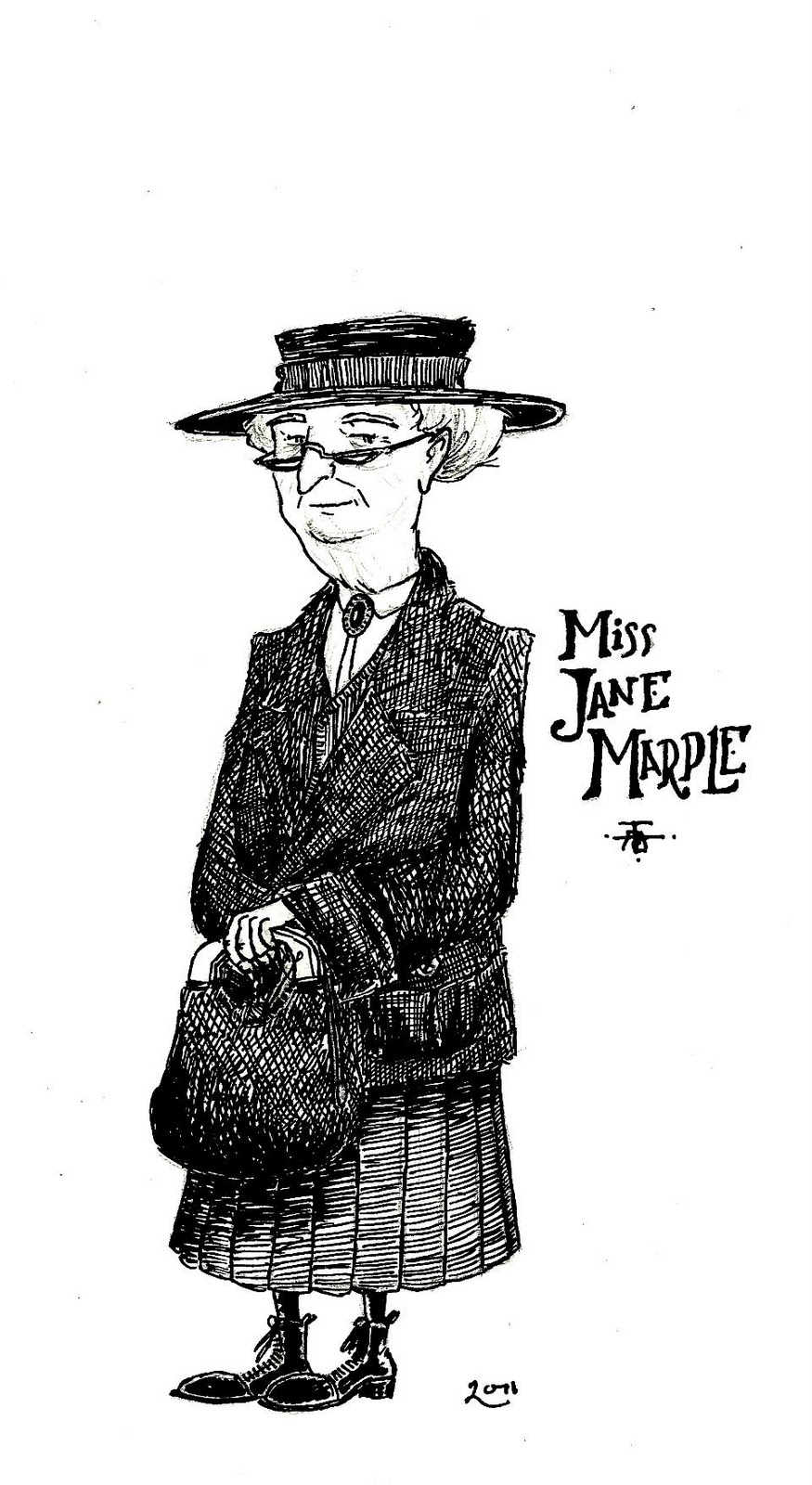
The Detective Scribbles, No. 4, Miss Jane Marple

This is the latest drawing in the series of doodles entitled "The Detective Scribbles," and this time it is the famous spinster detective who lives in the quaint little village of Saint Mary Mead, Miss Marple. This is sort of a sequel to a previous scribble, the one of Monsieur Hercule Poirot, so this is, more specifically, another tribute to the prolific crime writer, Agatha Christie. The character of Miss Marple, however, connects with me on a personal level. This is a favorite character of my father and I can see why. She is a very down-to-earth person who is as sharp as a tack. Marple is basically  a keen and specific detective who takes the guise of an old woman who knits. The character of Miss Marple is sensible, not eccentric like Poirot and that's what Christie must have thought about this character, too. There is an interesting story about Christie with her relationship with Poirot: Christie, much like the author Arthur Conan Doyle with his character of Sherlock Holmes, was sick and tired of Poirot and sick of writing stories about him. Some stories have come about that she wrote Curtain, Poirot's last case, just so she could say a sort of "that's it for you." Christie wanted to experiment with other characters besides Poirot, Marple was one of those other characters.
Miss Marple appeared in her first story entitled Murder at the Vicarage and since then (up until her last story entitled Sleeping Murder) she has sort of enchanted readers with her sharp logic and rapier-like way of solving puzzles. Marple was said to have been inspired by Christie's grandmother, who was said to be scarily like Marple, she could tell when there wasn't something quite right. Marple's surname even fits this character's personality. There is another story about her genesis, of her surname, at least. Christie went to an estate sale, or something of that sort, and bought a chair whose company name was Marple or that the people who owned the chair was the family Marple. Either way, to name a character after a chair just reflects how down-to-earth this character is, but, like I wrote before, she is as sharp as a tack. I love these sort of characters who appear to be one thing, but, in turn, surprise you with their characteristics. This is why Marple is one of my favorite detectives, and I know I say this with every detective, but I have always had a soft spot for Miss Marple because she does remind me greatly of my grandmothers, who could cut you to ribbons with their words. Basically, Miss Marple is a good detective and her stories are well written.
She, much like Poirot, has been adapted in various ways, but this drawing was inspired by the actress Joan Hickson, who I think was a nicely played Miss Marple. Of course, like with Poirot, I found out about Marple whilst watching a program that I have mentioned time and time again, the program is Masterpiece Mystery, which I rather enjoy. Nowadays, however, Marple is brilliantly portrayed by actress Julia McKenzie, who I think is comparable to Hickson in her portrayal. Now, until next time, I shall have another detective adorned on this blog soon, so keep a sharp eye out for my next post.
Notes: She was drawn using water-proof ink and a dip pen with a pencil to lightly outline some of the wrinkles and such.

Wednesday, September 7, 2011

The Detective Scribbles, No. 3, Kurt Wallander

Sorry about the long delay, but here it is, the next in the Detective Scribbles Series and this time it is the Swedish bloodhound, Kurt Wallander. This is, by far, the most disturbed detective that I have ever seen, but he does get the job done. This detective was the brainchild of Swedish author Henning Mankell and his books, along with the British version of the series on Masterpiece Mystery, a program I talk about often in this series of scribbles and meanderings, anyway, the books show a Sweden that is not blissful and beautiful, but it shows the dirty underbelly that is behind this picturesque facade.
Wallander's character was introduced in the story Faceless Killers, which is a story reflecting not only the pure evil of the crime, but of the dark sin of humanity, racism. Since then this detective has enthralled its readers throughout minute parts of the globe. I, personally and unfortunately, have not read the books by this author, but I have seen the series that stars Kenneth Branagh and it is very good. What I liked about the series is that the main character is basically a tortured soul, and you don't commonly find that in any other crime series, at least to this extent. Wallander fuels himself with junk food and has eyes as red as a bloodhound, I think that is how his author described him, and also this character basically kills himself inside and out through every single case, because he always feels personally responsible for every case that is handed to him. Again, I hate to sound like a broken record, but I have never seen such a fictional detective become so personal with their cases, take so much of it to heart. Wallander is a perfect detective with more than one vice about him, but that is what makes a good character I think, their graces are only as good as their flaws, and that is what makes Wallander one of my favorite detectives.
Wallander took quite a long time to figure out what he would look like. I thought at first that he should have blonde hair, but I thought it would see too cliche, since Wallander is not the stereotypical Swedish character. Then I thought that he should just be a dark character, since he is very much dark and macabre. He is a bit like the American gumshoe with the sprawling city as their home with the flickering fluorescent lights just outside their windows, Wallander is much like that sort of character. So then, with that in mind, I decided that he should have just very ratty things, since he takes very little care of himself, and just to make him more film noir-ish, I thought that he should have the upturned collar that is mostly hiding his haggard face. So I quickly drew him in pencil as an outline and drew over it with a dip pen, using waterproof ink, and then used the same ink, but instead I used a brush, to darken him, which seemed to fit Wallander quite nicely.
There are plenty more detectives to come in this series, so keep a sharp eye out for my next post.
Note: If you would like to explore the author Henning Mankell's website click here.

Wednesday, August 3, 2011

The Detective Scribbles, No. 2, Mister Nero Wolfe


For those devoted followers and readers to this blog, you will remember that I had sent out into the ether a little riddle. The riddle can be found in the previous post, to help reduce the rambling. Now, to continue, here is my new piece of work for the series entitled "The Detective Scribbles," and it is the corpulent American amateur detective Nero Wolfe.
For those who do not know of this colossal calculator, Nero Wolfe, here is a brief explanation. The character of Wolfe and his trusty sidekick, Archie Goodwin, came from the brain of one man by the name of Rex Stout, who was, coincidental, an Indiana native (which was a fact I didn't know about until early this summer). Stout, for those interested in his works, was born in Bloomington, Indiana, just a further explanation on the tid-bit of information given. Anyway, back to the character of Nero Wolfe. Wolfe made his first appearance sitting in his brownstone on West 35th street in 1934 in a story called Fer-de-Lance and it was well reviewed as being a work of genius. Since Wolfe's genesis was during a period known as "The Golden Age of Detective Fiction", Wolfe had more eccentricities than you could shack a stick at. For instance, Wolfe, who is described as being "a seventh of a ton" in the stories, is always punctual when it came to his meals, and his meals consisted of only the best cuisine that came from his manservant Fritz Brenner. When Wolfe was having his meals it was made clear that no one, absolutely no one, was to disturb Wolfe during his meals, which almost seems to border on the religious for any character.
Another of Wolfe's eccentricities was his absolute love of orchids. His orchidophile attitude was nearly as religious as his meals, note that I am sure that orchidophile is a severely made-up word. He tended to them as if they were family. Although these are just two of Wolfe's many eccentricities, it is true to form that Wolfe is the American version of Sherlock Holmes.
Speaking of which, you might find small, almost minute, similarities with Stout's Wolfe and Doyle's Holmes. One of which is very prominent, almost "a seventh of a ton" prominent, it is the almost uncanny resemblance to Holmes' brother Mycroft. You  could flip through the story of The Greek Interpreter and find some distinct similarities. Both of them are very, very corpulent computers, basically. It is even speculated in some circles that Wolfe is the child of Irene Adler and Sherlock Holmes, which could explain the resemblance. Also this could explain the similar amount of syllables in both Holmes' and Wolfe's names. But I shall quit this speculation and try to wrap this up.
To conclude this post I shall recommend that anyone interested in Crime Fiction, especially American Crime Fiction, try to find a copy of one of Rex Stout's analytical detective Nero Wolfe and his trusty sidekick Archie Goodwin, they are certainly entertaining. Click here to go to the wikipedia page about Nero Wolfe and the Wolfe stories.
Both of these drawings, sorry for the abrupt transition, were drawn with an old fashioned dip-pen that I had bought near at the beginning of the summer. I was not qutie sure which Wolfe picture to present on this blog, because I admire this character deeply, so I cut off all deliberation and decided to post both. The one at the beginning of this post was my favorite and most faithful out of the two because of the orchid, but I had accidently put Wolfe smiling, which I found to be odd since he is such a serious character, so this second one here sort of balances it out, I think, but it is a mere speculation. I shall, perhaps put some clues for the next detective in this series before the week's out, mainly because I am still deliberating which detective to draw next. If you, being, hopefully, a faithful audience, have any suggestions, please do leave them in the comment section of this post. Thanks.
Keep a sharp eye out for my next post.

Sunday, July 3, 2011

The Detective Scribbles, No. One, Monsieur H. Poirot

Here is the first drawing in a whole new series of doodles, entitled The Detective Scribbles. Hopefully, every week or so, I will have a new drawing that consists of a new fictional detective. This week is the most famous detective in the world, according to this character's "little gray cells," I am, of course, speaking of Monsieur Hercule Poirot, the brainchild of a very clever woman by the name of Agatha Christie. He was a Sherlock Holmes of a generation that just emerged from the first World War. This fastidious little character with his waxed moustache and seemingly infinite intellect emerged onto the literary scene in 1920 with his first adventure, The Mysterious Affair at Styles (a book that I would recommend for any bookworm who has an interest in crime fiction). Since his first adventure to his swansong in Curtain, Poirot and his fastidiousness that bordered on the obsessive compulsive had solved grand and marvelous crimes that enthralled the world because of his creator, Mrs. Christie.
He is one of my favorite fictional detectives because he's a character to sort of snicker at due his eccentricities such as how he keeps everything neat and tidy, much like his idiosyncratic moustache, and how it is said that even the slightest speck of dust would hurt more than a bullet. This little Belgian detective has had many actors who have tried to portray him on both the silver screen and the stage, but my favorite actor who has portrayed him is possibly the only one that I think could play Poirot to a T: that is the English actor by the name of David Suchet. If you have followed this particular blog with any particular interest, you will remember that I have mentioned a program called Masterpiece Mystery, which is on PBS. You will find that, at least at this present time, there is a new season of the Agatha Christie's Poirot that is currently airing, it's last episode in the season, Hollowe'en Party, is set to air...well...tonight, Sunday, July 3rd. So, to wrap up this quite lengthy post, I would highly recommend reading Christie's little Belgian detective and see his little grey cells at work, or tune into Agatha Christie's Poirot starring the quintessential actor David Suchet, if you are fans of crime fiction, I doubt that you will disappointed. Thanks for enduring the rambling. Keep a sharp eye out for my next post. (Note: I am well aware that the drawing sort of leans over, quite harshly, to one side, I am most sincerely sorry, it is the one of the faults of being right-handed.) Click here to check out this season of Agatha Christie's Poirot and also previous seasons of the program.