Monday, October 24, 2011

The Holmes Brothers

I have to say that both Sherlock Holmes and his brother, Mycroft, have always interested me ever since I first read "The Greek Interpreter" by Doyle. When I first read the story I was nearly as shocked as Watson was when he found that Sherlock had a brother, who, Sherlock admits, is far superior in an intellectual sense than Sherlock, which seems almost impossible to visualize. I must say that I enjoy the interaction between the Holmes brothers in the story when Watson witnesses both Sherlock and Mycroft having a sort of battle of wits as they are looking out the window and analyzing and using pure inductive powers. I was just enthralled by the scene in the Diogenes Club and I liked how it also reflected how alike both of the Holmes brothers are. Both Mycroft and Sherlock share almost the same immense intellect and how they guess a man's profession and other details of a person from pure observation. So, with this in mind, I wondered what their signatures would look like.
 It is clearly stated in the story of "The Greek Interpreter" the natures of both of the Holmes brothers. Mycroft is basically very sloth-like and, my favorite line is, when Watson shakes hands with Mycroft he describes it as "shacking the flipper of a seal", or something around those lines. Mycroft sits in his chair most of the day at the Diogenes Club and observes the world from his room. Sherlock, on the other hand, is a great ball of energy that must be on the move every minute of every day. Mycroft himself observes that Sherlock is the energetic one in the family. I just thought that their signatures should reflect such an attitude with both of the brothers.
Mycroft's signature, the first one at the beginning of this post, is far more official, since Mycroft is a government bureaucrat, and is the signature that he would typically use when signing such forms. The second one, just below the ramble you are now reading, is the one that he uses on a typical, letter-writing basis, which reflects his pure laziness and sloth-like attitude with matters. Sherlock's signature, on the other hand, is more of a swooping signature, full of energy. The first one on this post is much like Mycroft's official signature, this signature is the one that Sherlock would possibly use for his "official" letter-writing, if he were writing to diplomats saying that he retrieved the Lost Diamond of the Maharaja
 or something of that sort. The second signature of Sherlock's is possibly one that he could use to write Lestrade or someone that he had found out the culprit of the crime or that he had found something.

I merely thought that it was an interesting experiment to play around with the Holmes Brothers signatures, basically to see what they would look like and how their signatures reflect their nature. Both signatures were written in blue waterproof ink with the use of a dip pen, sorry about the smudges, at least on Sherlock's, it was intentional with Mycroft's common signature.
Also, if you would like to see the scene with Mycroft and Sherlock, I have posted below a video of the Jeremy Brett version of "The Greek Interpreter" if you would like to take a gander. Sorry about the shoddy quality.
Until next time, keep a sharp eye out for my next post.

Sunday, October 23, 2011

The Detective Scribbles, No. 6, Father Brown

In 1910 an English literary critic and scribbler G. K. Chesterton introduced the world to the diminutive Catholic priest, Father Brown. I thought that it was very interesting to find such a character in the realms of detective fiction. There have been other religious detectives such as Brother Cadfael created by Edith Pargeter and Father John Blackwood created by Father Andrew Greeley, but one of my favorites is Father Brown.
The story that introduced Father Brown to the world of detective fiction was a short story entitled "The Blue Cross," and it was published, in the Holmesian tradition, in a magazine titled The Story-teller in September of 1910. In the story it introduced not only the diminutive Father Brown to the wide range of characters that would encapsulate the stories of Father Brown such as the elusive thief, M. Hercule Flambeau. What is interesting about the Father Brown stories, for the time, was that it was an era which was still, blatently, Sherlock Holmes' world. The mind of Sherlock Holmes is analytical and inductive research proved everything, while Father Brown based all of his evidence upon pure, inate intuition. Although Father Brown is the lesser known detective on the spectrum compared to Sherlock Holmes, this scribbler thinks that he the gentler, kinder person on the spectrum, compared to the calculating Holmes. It's best to think of it this way: in Christie terms, Sherlock Holmes is Hercule Poirot while Father Brown is Miss Marple, two completely different detectives that bloomed and flourished at almost the exact same time. That is probably why I enjoy the Father Brown stories as well as the Miss Marple stories, both Father Brown and Miss Marple are characters who are very friendly and kind as well as diminutive but are as sharp as a tack and solve mysteries that virtually baffle the authorities and those around them.
Now, to get back on track, you, being the diligent reader, will notice that I use the word "diminutive" quite frequently, almost to the point of redundancy, in this post, but that is the only fitting word that in my arsenal that I think truly fits this particular detective. In the stories by Chesterton, Father Brown is described as being short, stubby with a large umbrella at his side, hence why I had drawn him looking like he was almost three feet tall with an amiable grin on his aged face. Father Brown was quite a joy to doodle based upon Chesterton's description. Chesterton had written over fifty Father Brown stories and were published in various volumes and they go in order as such:
The Innocence of Father Brown
The Wisdom of Father Brown
The Incredulity of Father Brown
The Secret of Father Brown
The Scandal of Father Brown
The Father Brown stories are also posted online and I have provided links so that you, diligent reader, shall enjoy Chesterton's Father Brown stories as much as I have. As a final note, this drawing was done in the similar fashion as Miss Marple; with a dip pen with waterproof ink and a pencil to emphasize the wrinkles and the umbrella.
Right-o, until next time, keep a sharp eye out for my next post.

Monday, October 10, 2011

Melancholy & Renaissance

Currently, in one of my classes, we (the students in the class) were meant to draw a small doodle to commemorate the tenth year since The Twin Towers were reduced to rubble. Now this was a project that I thought quite long and hard about, considering the fact that this scribbler basically does cartoons and other such things. When trying to find an idea, I was looking through some old political cartoons, primarily drawn by Thomas Nast, James Montgomery Flagg, and other artists. When I found Flagg's painting of Uncle Sam in the iconic recruitment poster with the words "WE WANT YOU FOR THE US ARMY". Then I had sort of an idea of two different drawings. The first one was the three personifications of the United States: Uncle Sam, Colombia, and Brother Jonathan. The three personifications were drawn to look very haggard and weathered with the silhouette of the twin towers underneath them. Now, like all personifications of various countries, all three of these characters possess three definite colors: red, white and blue. So, basically and obviously, I only worked with those colors, with the rest of it (including the silhouette) was in black and white. I achieved this through the use of red, blue, and black waterproof ink that I had purchased, completely by coincidence, some months prior to the assignment. Basically, that was the first drawing.
The one that is presented before you, dear reader, was my second idea. It entirely in black and white with a weathered Uncle Sam rolling up his sleeves and brandishing a hammer (a badly drawn hammer). This was basically more of a cartoon and very much in my element than the previous drawing. The reason why it is in black and white, however, was because the teacher had told us later, after I had completed the first colored picture, that the entire thing was going to be in black and white rather than in color; so, I attempted to complete that bit of the assignment, a vain attempt to even the scales in my favor. The picture basically symbolizes how the United States has sort of carried on from the attack, even though we emerged thoroughly battered and bruised, we carried on and rebuilt ourselves, basically. This drawing was done with black waterproof ink and a pencil to shade in some particular parts in the drawing.
Right-o, until next time, keep a sharp eye out for my next post.

Thursday, October 6, 2011

Birdmen, Bow-ties, & the Slightly Macabre

 These are some scribbles that I quickly drew one day. The first doodle here is reminiscent of the Birdman that can be seen in the posts labeled under "The Brilliance of Boredom" series. Frankly, I merely enjoy drawing this particular character when I am completely bored.
This second character was also a doodle whose genesis was pure boredom, but the inspiration, though, was derived from various sources. One of the inspirations was from Celtic mythology. There is a sort of entity in Celtic myth that is called the Dullahan, which is sort of a headless coachman who drives a big, black coach (some even say that the horses that help propel the cart are headless as well). Well, when this scribbler says "headless", some say that the Dullahan can actually detach his own head and chuck it about at various objects. So, I was just pondering, for some odd and completely obscure reason, how that might actually work and the various complexities about it. Thus, I thought that the Dullahan could possibly have a great, round, metal head, just in case. Thereby, the head basically hovers over what was once the neck of the Dullahan, but this is just basically an over-explanation over a small little doodle. Another inspiration for this sort of makeshift Dullahan was an artist that I admire, Mike Mignola, the creator of the comic Hellboy. One of Mignola's common characters he's famed for, besides Hellboy, is a sort of dapper kind of specter whose head is merely a floating skull, as you, being the diligent reader, can gather, was a great inspiration for this little Dullahan.
Right-o, until the next post, with hopefully a new detective in "The Detective Scribbles" series, I shall now stop. Thanks for enduring through the rambling. Keep a sharp out for my next post.

Saturday, October 1, 2011

The Detective Scribbles, No. 5, Chevalier Auguste Dupin

The new detective to adorne the series entitled "The Detective Scribbles" is one of Edgar Allan Poe's creations, C. Auguste Dupin. Although the Master of the Macabre only featured this character in three stories, he has inspired the writers of the past and present to create some of the world's greatest detectives, such as Sherlock Holmes. Poe wrote the first Dupin story in 1841 and it is the mystery entitled "The Murders in the Rue Morgue" in which Dupin had to find the culprit behind a vicious murder. Since "Rue Morgue," and after his other two stories ("The Mystery of Marie Roget" in 1842 and "The Purloined Letter" in 1844), the Parisian detective has enticed the world of Crime Fiction, just as his creator did with the genre that are akin to his dark and macbre tales.
In the design of Dupin, I personally thought about it for quite some time. Although many officials who have researched diligently on the subject of crime fiction and of Dupin, which some have speculated that he is a tall, dark, and handsome man, like many gentlemen detectives, I thought that he would look more like Poe, himself, as a Parisian, including the pointed, waxed moustache, much like Poirot, since the character of Dupin inspired the creation of Poirot, too. In the design, I thought I would add little snippets and characteristics of the classic detectives that came after the Dupin stories: for instance the sweeping coat that is similar to the inverness cloak that is commonly associated with Holmes, and the strict moustache of Poirot (although Poirot's is far more strict that this character's), along with the sort of profile that is similar to his creator, Poe himself. Since this is a Poe character, I thought that it would only be appropriate that he would be dressed in black with a sort of old coat to blend in with his environment when he is stalking the streets at night, much like Holmes wearing a disguise in some of his stories, which was actually inspired by Dupin as well. Poe, in general, is one of my favorite authors since I was a child, so I truly admire how he had inspired the realm of crime fiction.
The drawing was done with a dip pen with waterproof ink and a pencil to do the details in the coat and tie. Below here was a photograph of Poe that inspired the drawing you see before you, dear reader. Keep a sharp eye out for my next post.

Saturday, September 17, 2011

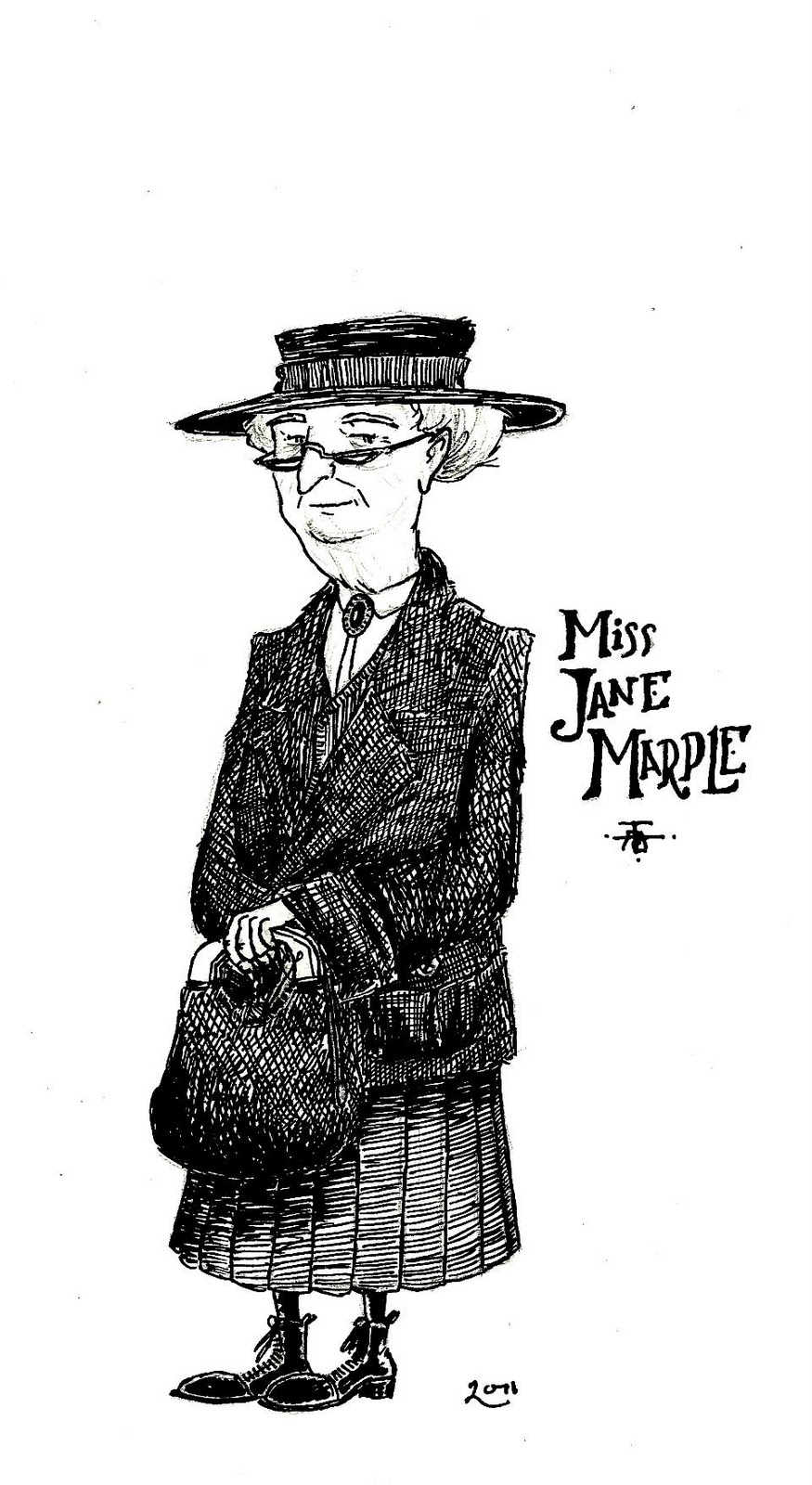
The Detective Scribbles, No. 4, Miss Jane Marple

This is the latest drawing in the series of doodles entitled "The Detective Scribbles," and this time it is the famous spinster detective who lives in the quaint little village of Saint Mary Mead, Miss Marple. This is sort of a sequel to a previous scribble, the one of Monsieur Hercule Poirot, so this is, more specifically, another tribute to the prolific crime writer, Agatha Christie. The character of Miss Marple, however, connects with me on a personal level. This is a favorite character of my father and I can see why. She is a very down-to-earth person who is as sharp as a tack. Marple is basically  a keen and specific detective who takes the guise of an old woman who knits. The character of Miss Marple is sensible, not eccentric like Poirot and that's what Christie must have thought about this character, too. There is an interesting story about Christie with her relationship with Poirot: Christie, much like the author Arthur Conan Doyle with his character of Sherlock Holmes, was sick and tired of Poirot and sick of writing stories about him. Some stories have come about that she wrote Curtain, Poirot's last case, just so she could say a sort of "that's it for you." Christie wanted to experiment with other characters besides Poirot, Marple was one of those other characters.
Miss Marple appeared in her first story entitled Murder at the Vicarage and since then (up until her last story entitled Sleeping Murder) she has sort of enchanted readers with her sharp logic and rapier-like way of solving puzzles. Marple was said to have been inspired by Christie's grandmother, who was said to be scarily like Marple, she could tell when there wasn't something quite right. Marple's surname even fits this character's personality. There is another story about her genesis, of her surname, at least. Christie went to an estate sale, or something of that sort, and bought a chair whose company name was Marple or that the people who owned the chair was the family Marple. Either way, to name a character after a chair just reflects how down-to-earth this character is, but, like I wrote before, she is as sharp as a tack. I love these sort of characters who appear to be one thing, but, in turn, surprise you with their characteristics. This is why Marple is one of my favorite detectives, and I know I say this with every detective, but I have always had a soft spot for Miss Marple because she does remind me greatly of my grandmothers, who could cut you to ribbons with their words. Basically, Miss Marple is a good detective and her stories are well written.
She, much like Poirot, has been adapted in various ways, but this drawing was inspired by the actress Joan Hickson, who I think was a nicely played Miss Marple. Of course, like with Poirot, I found out about Marple whilst watching a program that I have mentioned time and time again, the program is Masterpiece Mystery, which I rather enjoy. Nowadays, however, Marple is brilliantly portrayed by actress Julia McKenzie, who I think is comparable to Hickson in her portrayal. Now, until next time, I shall have another detective adorned on this blog soon, so keep a sharp eye out for my next post.
Notes: She was drawn using water-proof ink and a dip pen with a pencil to lightly outline some of the wrinkles and such.

Friday, September 16, 2011

A Good Brolly (Umbrella)

Here's just a sort of Rembrandt-esque sort of experiment that I did merely to experiment with using a brush instead of a dip pen (granted, I am no Rembrandt, but this was just an experiment, none the less). Here's a small story that is behind these this little doodle: I had recently purchased a nice umbrella from Barnes and Noble, one of my favorite places to go to. The umbrella, on the top, has different quotes from various bits of literature, so it was a favorite utensil of mine quite instantly. This is where the "brolly" part comes in, the term "brolly", if anyone isn't aware of colloquialisms, is a another term for an umbrella and I simply could not fit the word "umbrella" into the format, so I used the term "brolly" and mainly because I love the whimsy of the word itself. What I have here is the edited and unedited version of this picture, but never fear, I will try to not be this egotistical with my future posts, I will have another detective on here for "the Detective Scribbles" series by the end of the weekend.
Keep a sharp eye out for my next post.

Wednesday, September 14, 2011

Glorious Rebellion

This is a caricature that I recently was commissioned to do for a friend of mine who is in an awesome band called Glorious Rebellion. Simply their music is great and the members in this band are truly great folks. Honestly, I was surprised to be commissioned for this caricature, but I am honored to have scribbled this drawing for some good friends. If you would like to sample some of this band's music go to their Glorious Rebellion facebook page by simply clicking here (go to the "band profile" part of the page to listen to some of their music), I would just like to thank my friends for giving me this prestigious opportunity.
Notes: the drawing was done with regular ink drawn with a dip pen (this was a vital ingredient for the ink washing effects that "frame" the picture) I also used the typical waterproof ink to darken it a bit and regular pencil to create the shadow-like effects.

Monday, September 12, 2011

A Couple of Heartfelt Ravens


I have been experimenting in silhouettes for the past couple of weeks, these are only some of the early experiments. These were done with waterproof ink and I used a dip pen to outline the actual ravens and a paintbrush to create the sort of frame around it. I then used a red permanent marker to create the mere hints of red in each of the small doodles. Do comment and tell me what you think.
Keep a sharp eye out for my next post

Friday, September 9, 2011

A Mere Piece of Golden Diction

Here is one of my favorite poems that is titled "Ode" by the Irish poet Arthur O'Shaughnessy. It is one of my favorites because it reminds me of a show that I watched as a kid, called The Storyteller, which starred the brilliant John Hurt & Michael Gambon in two grand seasons. In particular, it reminded me of a small part in the episode titled "A Story Short" and when a King is asking the Storyteller (John Hurt) of his occupation he responds thus:
"I am a teller of stories. A weaver of dreams. I can dance, sing, and, in the right weather, I can stand on my head. I know seven words in Latin and a little magic trick or two. I know the proper way to greet a dragon. I can play dirty, but not fair...I am not domestic, I am a luxury and in that sense, necessary."
This is but an approximate quote, but it is one of my favorite quotes. I, being a scrivener, adore stories and think that they are truly the most necessary things that we need, besides breathing, of course. This might seem a bit overdrawn, but I don't. There can be nothing more necessary, but this is merely a love letter to such a profound part of our culture, that is all. I have no scribbles to produce today, just this. A mere poem, but is by far one of my favorite poems that I have read, next to Emily Dickinson's "Hope is a thing with feathers" that is, 
but I'm getting ahead of myself.
Keep a sharp eye out for my next post.